Possible alternative music to emerge at mid-summer Suntory Hall: Cosmology of gamelan weaving “the world’s most beautiful sound”
At en-gawa (= terrace built at the edge of the house) in mid-summer. En-gawa is situated in a unique space, neither inside nor outside of the building. Among the frequent questions which are asked by the Westerners with respect to gardens in Kyoto, “Is en-gawa situated inside or outside of the building?” is an impressive one to me.
In the ’80s, there were multiple possibilities and alternatives for information technology that emerged before us, human beings. To express their potential, the “conceivably” dream-like world was illustrated, and also the dystopia at the same time. After several decades have passed, finally we are making a choice and relinquishing other possible alternatives.
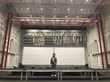
Suntory Hall: designed “in pursuit of the world’s most beautiful sound”.
Midsummer Feast – the festival of Western Music in midsummer – is held in European countries at high latitudes. And especially in northern European countries where the sun never goes down in this season, traditionally, events with non-stop music throughout the night, have been held. These annual traditional events were gradually developed in the context of jazz and rock music in Britain and from the ’60s to ’70s evolved and established as gigantic outdoor music festivals in parallel with the revolution in youth culture. Many music festivals in Japan held during the Summer vacation season too emerged originally from this same context.
Suntory Hall Summer Festival is the annual festival of contemporary music that has been held since the opening of Suntory Hall in the ’80s by Suntory Foundation for the Arts, and has been presented by Suntory Hall since 2018.
The festival was launched with the theme of a music competition for kids and “the music of the 20th century” in the ’80s and since the ’90s composers who overthrew the foundation of music such as Schoenberg, Ligeti, Xenakis, Prokofiev, John Cage, together with composers from Japan and China in early times, have been introduced as theme composer. That tells the concept of the festival well enough. This time, the festival has 3 major programs; “The Producer Series”; “Theme Composer”; “Competition of Yasushi Akutagawa Suntory Award for Music Competition”.
Suntory Hall’s main hall was designed “In pursuit of the world’s most beautiful sound” in “vineyard style”. The vineyard style was first adopted for the hall of the Berliner Philharmoiker and was conceived by the architect Hans Scharoun, in accordance with the ideas of the revival of the culture of German cities devastated by the bombing in Berlin.
Suntory Whisky has an original brand called “Hibiki”, means acoustics or resonance in Japanese, which has a double meaning that is the harmony of blending multiple aromas and tastes for one and harmonizing nature and humans for another. In this wise, there seem to be deeper visions in Suntory’s company culture regarding the term of “Hibiki”.

“An Alternative Gamelan by Masahiro Miwa”
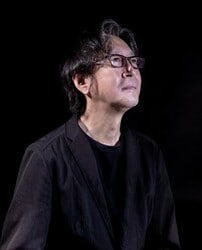
The program titled “An Alternative Gamelan by Masahiro Miwa” produced by him is one high-lighted theme of this year’s festival. The art collective “Kita” with members of multiple nationalities from Japan and Indonesia is directing the program and Marga Sari Gamelan Ensemble oriented in Java Gamelan tradition performs music composed by Mamoru Fujieda, Masako Koide, Yasuno Miyauchi, and Makoto Nomura.
The concert program titled “Music in the Universe” (one of two programs of “the Producer Series”) is held at the main hall on August 27 (Sun.), which newly commissioned works by the above-mentioned composers and Gongs and Bamboo by José Maceda who was the composer of the Philippines known as an ethnomusicologist too. The work of Maceda is the composition for gamelan ensemble, ryuteki, bamboo instruments from the Philippines, doouble bassoon, and children’s choir. Local instruments from the West, Japan, the Philippines, and Gamelan (Java oriented) will be in harmony beyond each tonality. The music is based on the concept to allow each instrument, without giving any principal role to them, to be independent of the others and integrated overall.

Another one is the “project type” concert program titled “En-gawa” from August 25 (Fri.) to 27 (Sun.). In this project, probably Kita who is in charge of the project direction has a key role. Kita means “we” in Indonesian. They adopt the form of free organization with non-fixed members of multiple nationalities. So it is obvious that they are not in authentic concert hall-style production. The open house where Gamelan Ensemble performs is installed inside the Blue Rose (Small Hall) and accommodates many performing arts of different genres and Gamelan there. Also, street stalls are set up, and on the nights of August 25 (Fri.) and 26 (Sat.) symposium titled “Gamelan Assembly” is held.
This “En-gawa” program has no intermission. There are no fixed openings and endings, and the space is always filled up with music. It is not the tense atmosphere that music provides in the space, but the slow one in which sound from people’s small talk around the street stalls blends.
Originally, Suntory Hall itself is designed to be accessible for all the people who love music. It could be said that the “En-gawa” is their original point of return after a long roundabout.
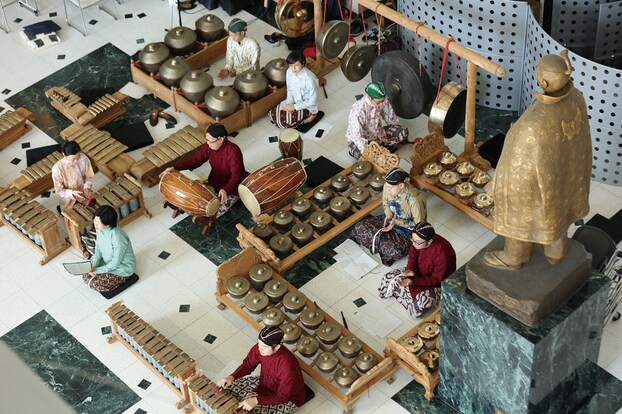
At “En-gawa” in mid-summer
Meaning of people-gathering for music
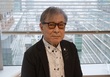
A text is contributed to the festival brochure by Masahiro Miwa, titled “An Alternative Gamelan – Music in the Universe”. There he mentions once he had conceived “imaginary music that possibly had existed” and the experience that this idea dramatically sublimated when he came across Gamelan Music.
In Gamelan you find a distinguished logic from the concept of tonality in modern Western music. Each instrument without fixed tonality establishes the whole body of music and an elaborate sound through subtle differences in tuning and creates countless harmonies.
Then on the contrary, what was the meaning or the function of Western music for the civilization of the entire planet? One of the answers to this question is that Western music enables us to realize accurate notation and re-presentation based on it. Music obtains “universality” by its capacity of setting an “accurate” scale or measures. As time has passed, the newer the technology becomes, the more accurate re-presentation of the work becomes available. Unnoticeably, this makes us believe that music is something to be recorded or reproduced.
He makes a distinction between “enjoying music (=ongaku)” and “enjoying recording (=rokugaku)” and gives each a clear definition as in a distinction between a drama and a film. Probably, the core and essential issues of the most importance this time are “What did the universality, accuracy, and re-productivity of Wester Music bestow on and take away from human beings? What on earth did Western Music relinquish?”
It is not a coincidence that this kind of conversion from the side of Miwa who researches the involvement of algorithms and technology over people suggested. Something, which is rather found only by the artist who has pursued the possibility of technology. I have an impression from his works founded on mathematical simulation or algorithms that there seems a conviction that humans could not attain a perfect re-presentation. Human activities always contain mistakes, misdeliveries, fluctuations, and gaps. And yet between technology and physicality, there work cosmic balances to retrieve them. Then he seems to try to find something interesting and beautiful there.
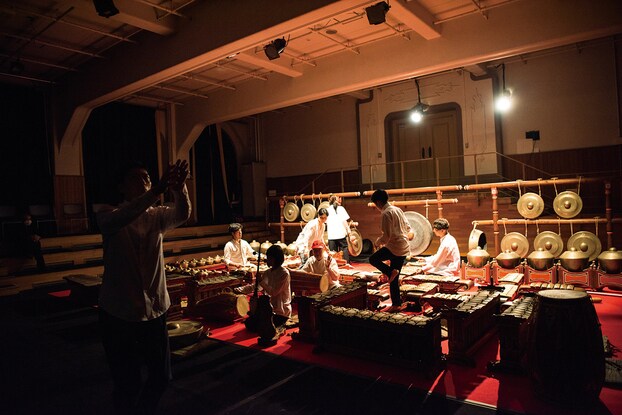
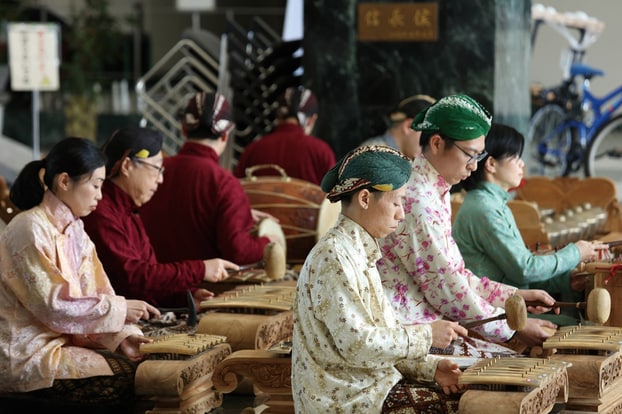
And probably, an issue that many artists have had to tackle the very meaning of people-gathering to the music over the last three years, is to do with this program. Musicians have been forced to give fundamental reconsiderations at the level of human history over the ecosystem of music and the meanings of people-gathering over the last three years. The moment when society is finally making a move again, to accept “En-gawa” as an answer from the producer makes this program very interesting.
Although our predecessors had imported and learned from what the civilization of the West developed itself, at the very phase of exhausting modernity and Western Europe, the music has no choice but to face its primal state which Western Europe has been trying to subdue through contemporary music these days.
At the beginning of the above-mentioned text, he refers to the idea that Gamelan always reverberates with each other (without man-made performance) and shows up or then not. This is the thought that the universe perpetually reverberates and humans always “listen to it”, so here “an attitude to listen” and “an attitude to strain your ears” become important.
With the one-day-pass, you can enjoy unlimited access to the performances without any designated start or end time or specific seat area to listen from. At this point, we do not have to mention that modern Western music and the concert hall reflect the concept of one-point perspective drawing, known as perspective drawing. The “project type” concert program is probably one of the answers to the limit that Gamelan performs in the closed concert hall.
Where to take the direction in the present day, and for composers and music to be “actual”
“聖” (= holiness), with the constituents of the kanji character illustrating King (= 王) with the distinguished hole (= 口) at ears (= 耳) renders the idea of King for humans – a person who can hear the voice of God – in ancient China. “聖人” (= holy man) is the person who can hear out the voice of God. According to the viewpoint of the Japanese, knowing how the holy man is may access the core that the “performing art” in the Middle age tried to reach.
I think this year’s Suntory Hall Summer Festival takes the pass to face seriously such issues as where to take the direction in the present day and how to be “actual” in subsequent situations. Providing that the cosmology in Gamelan is to meet the sound from nature and the universe, “the possible alternative music” would seem to reconsider even the framework of music and come forward to the very sound of the world and the universe. Something resolving into “the sound” itself, and harmony between humans, culture, and technology, there I have an irresistible feeling that there actually might be something to be integrated into “the sound”. It is too an experiment to redefine “the most beautiful sound in the world” which has been the ultimate goal for Suntory Hall which symbolizes the Western modern culture in our country.
LIVE INFORMATION
Suntory Hall Summer Festival
■The Pruducer Series: An Alternative Gamelan by Masahiro Miwa
August 25 (Fri.) to 27 (Sun.), 2023
The Project Type Concert: En-gawa
August 25 (Fri.), 2023, 13:00-20:00 *Concerts at En-gawa / The Night Program “Gamelan Assembly I”
August 26 (Sat.), 2023, 13:00-20:00 *Concerts at En-gawa / The Night Program “Gamelan Assembly II”
August 27 (Sun.), 2023, 10:00-17:00 *Concerts at En-gawa
Project direction: Kita (Anastasia Yuanita, Kitazawa Jun, Siti Sarah Rayhana, Shohei Tsuda, Junpei Nosaku, Yuki Miyata, Munif Rafi Zuhdi) *Kita means “we” in Indonesian
Musical direction: Java gamelan ensemble Marga Sari (Members: Naoki Ebisuya, Takuya Oi, Gaku Kurokawa, Kanna Taniguchi, Shin Nakagawa, Manami Nishi, Akihiro Nishimura, Midori Moriyama)
The Night Program “Gamelan Assembly”
I: August 25 (Fri.), 2023, 19:00-20:00 at Blue Rose (Small Hall)
II August 26 (Sat.), 2023, 19:00-20:00 at Blue Rose (Small Hall)
Host: Masahiro Miwa
Music in the Universe
August 27 (Sun.), 2023 at Suntory Hall (Large Hall)
Open / Start: 16:20 / 17:00
José Maceda (1917-2004): Gongs and Bamboo for Gamelan, Ryuteki (Piccolo), Double Bassoon, Percussions, Choir (1997)
Noriko Koide (1982-): Legit Memories (2023) *World premiere
Makoto Nomura (1968-): Tarik Tambang (2023) *World premiere
Mamoru Fujieda (1955-): Concerto No. 2 for Piano and Gamelan (2023) *World premiere
Yasuno Miyauchi (1980-):SinRa (2023) *World premiere
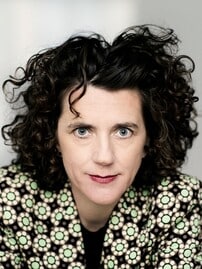
Theme Composer: Olga Neuwirth
Suntory Hall International Program for Music Composition No. 45 (Artistic Director: Toshio Hosokawa)
©Harald Hoffmann
Music Composition Workshop x Talk Session (with Japanese Interpretation)
Workshop by Call for Scores
August 23 (Wed.), 2023 at Blue Rose (Small Hall)
Open / Start: 18:20 / 19:00
Lecture: Olga Neuwirth / Toshio Hosokawa
Orchestra Portrait (Commissioned Work Program)
August 24 (Thu.), 2023 at Suntory Hall (Large Hall)
Open / Start: 18:20 / 19:00
Olga Neuwirth (1968-): Orlando’s World (2023) *World premiere, commissioned by Suntory Hall
Olga Neuwirth: Masaot / Clocks without Hands for Orchestra (2013)
Alexander Scriabin (1872-1915): Symphony No. 4, Op. 54, “Le poème de l’extase” (1905-08) etc.
Performance: Virpi Räisänen, Mezzo-Soprano* / Matthias Pintscher, Conductor / Tokyo Symphony Orchestra
Chamber Music Portrait
August 28 (Mon.), 2023 at Blue Rose (Small Hall)
Open / Start: 18:20 / 19:00
Olga Neuwirth: Quasare / Pulsare II for Violin, Cello and Piano (2016)
incidendo / fluido for Piano and CD Player (2000)
…ad auras… in memoriam H. for Two Violins and Wooden Drum ad libitum (1999)
Magic Flu-idity for Flute Solo (and Typewriter) (2018)
spazio elastico for Ensemble (2005)
■The 33rd Competition of Yasushi Akutagawa Suntory Award for Music Composition
August 26 (Sat.), 2023 at Suntory Hall (Large Hall)
Open / Start: 14:20 / 15:00

Yu Kuwabara (1984-): Falling Leaves Moon Steps (2023) *World premier, commissioned by the Suntory Foundation for the Arts
Hiroki Tanaka (1999-): Trace/Spiral (Différance II) for Orchestra (2021-2022)
Junichi Matsumoto (1973-): Half-Forgotten Floors, or Rooms for Scordatura Group and Orchestra (2016 / 2018 / 2022)
Wataru Mukai (1993-) : Dancing Queer for Orchestra (2022)
Suntory Hall Summer Festival 2023 official site: https://www.suntory.co.jp/suntoryhall/feature/summer2023/