
“The duel” by the language of “the flesh,” capturing “the life” overcoming the curse of the death of a supreme novelist.
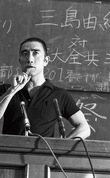
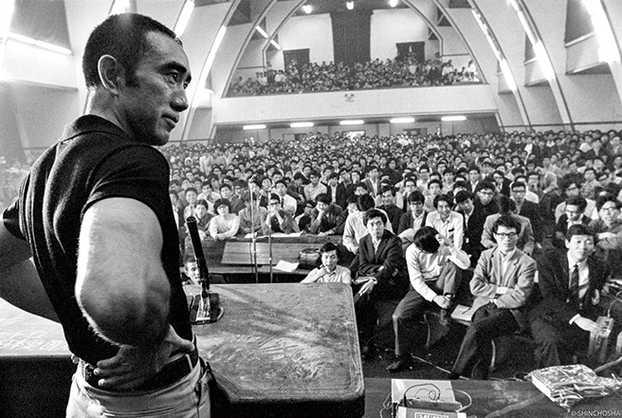
There is one black and white photo (the world “to be seen.”) Yukio Mishima (hereafter refereed as YM) stands perfectly motionless with hands on his hip, smiling calmly. And unforgettably large eyes of his, stare at his right side. His body tightly in a polo shirt exposes his muscularity in front of the microphone on podium. Before him, a crowd of young boys and girls are jostling — the seats in the conference room are occupied by them up to the second floor. The aisles are filled by the audience standing — and focusing their eyes tightly on Mishima on the stage, but somehow they seem enjoying the situation.
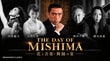
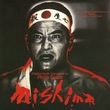
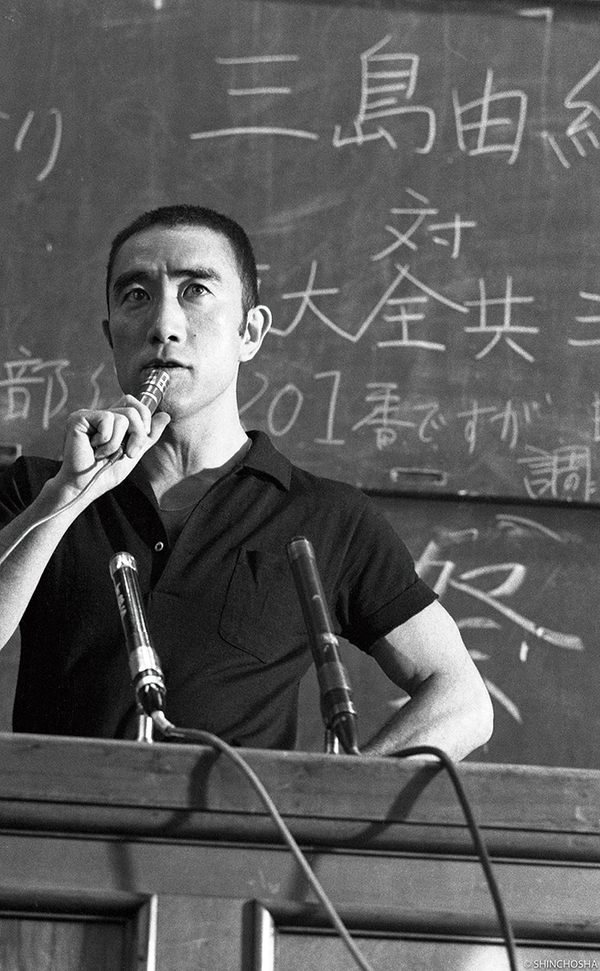
May 13 of 1969, on the day when this photo was taken, room 900 at Komaba Campus of Tokyo University (hereafter referred as TU,) was filled with uncanny enthusiasm. Some volunteers from the All-Campus Joint Struggle Committee (hereafter referred as ACJST) of TU planed to hold an open debate with Yukio Mishima there. ACJST of TU had just lost an important battle of “political season” in late 60’s against the regime at the time. Meanwhile, Mishima, a prominent novelist, had been gaining international expectation as a nominee of Nobel prize for literature till 1968, the year when Yasunari Kawabata won the prize. He had also drawn public attention as a writer who had been preoccupied gradually by the extreme rightist tendency, and as a leader who formed “Tate no kai (Shield Society,)” a paramilitary group last autumn before the debate. It was explicit for both sides that the common issues then was “Violence” and “Radicalism”. An episode that Mishima held off the offer to put himself under the convoy of the police could fill us with an atmosphere of the place and the tension of the time. We are able to learn what the issues were between them under an extremely delicate situation by the script published as the book later The Debate between Yukio Mishima and ACJST of TU — The Beauty and Community, and the Struggle at TU. Half a century after the debate, the documentary film “Mishima: The Last Debate (三島由紀夫vs東大全共闘 50年目の真実, literally “Yukio Mishima vs. ACJST of TU — The Truth Revealed in the 50th Year”)” will be put on the screen. The film is based on the footage filming the debate.
Does the film bring us something which can have never been retrieved by the texts? Let me think about it together with the interview to the film director, Keisuke Toyoshima (hereafter referred as KT). The film proceeds chronically along with inserted news video of the time one after another, feeding necessary information to reconstruct the historical background. That is to say, the film follows the time line of the debate from its start to the end faithfully. Newly shot interviews to the experts of Mishima and those days, and members of ACJST appeared in the debate, are arranged to support proper understanding of the issues debated, at each time necessary to do so. The direction of the film pursues ongoing debate faithfully, and it brings us vivid inspiration, which also impresses me.
“Born after Y. Mishima’s death, I admit myself not to have been a good reader of his. This subsequently led me to read numerous critical biographies about him, and I found that many of them started with the question “Why did Mishima bring his life to the conclusion?” It is understandable that the incident (Mishima’s suicide by the sword in 1970) was impulsive and traumatic for people living in same period. But it is just one of those historical events for us as of now. Our generation has been keeping distance from political activity and struggle, and knows “Political Season” ambiguously. Then I have to ask myself what is necessary for us to tackle those issues seriously. Reviewing the footage of the debate finds Mishima’s smart and resilient behavior to the students. There remains his vigorous life and wonderful smiling face. And something hit me there. The question to start with is not “Why did Mishima bring his life to the conclusion?,” but “How did he spend his life?”. To start the documentary with the latter question, I decided to scrutinize the debate on the footage. Then I came to believe those visuals of the debate are precious and actual evidences that show bright and energetic side of Mishima’s life. The whole should be put to the public eye.“ (KT)
Above Toyoshima’s statement makes reasons to watch this movie clear. Shocking and traumatic death of Mishima has been putting a spell on posthumous interpretations of his works. However, whether he was aware of his impending suicide by the sword or not at that point, — he mentioned suicide conceptually in his keynote at the beginning of the debate — his visual images there is vigorous and energetic. Whether the interpretation worships him as a hero of patriotism, or derides him as a naked king, both interpretations still start with common ground irradiated reversely by his suicide. Instead, offering the perspective from “living Mishima”...
The film captures so many phenomena above mentioned book can not. Such as a funny scene of Osamu Kimura, a producer of this debate who also presided at the debate, and appears on the film as a witness of the debate after 5 decades later. He, who was an undergraduate of TU, unintentionally announced Mishima as a “Teacher” on the stage. Soon after that, he corrected his mistake, but justified himself by admitting Mishima as a better professor than that of his. Watching it for the first time, I learn that this mistake eases the tension between them, and subsequently leaves positive effect on following debate. At this moment, the eyes of the camera pan from nervous Kimura in the student uniform, and zoom up toward Mishima, who is smoking, smiling, and taking a rest (impossible moments to be captured by the letters).
Or, employing “Theatrical Space” by Masahiko Akuta (he is another witness and appears also on the film) to the debate is not only for the purpose of increasing its density but the intervention by “dumb show”, which is unretrievable by the letters. In the faint laughter from the audience, Akuta is approaching to Mishima from outside the camera, and lights up Mishima’s cigarette in his mouth. This shows a beautiful movement of the particular instance which recent anti-smoking customs wipe off from the screen. And these are impressive cinematic moments.
“Physicality“ of the film is the basis of these impressive details (margins.) Since 1960, Mishima had been trying to be as an accomplished man of “scholarship and the martial arts.” For him then, the writings of pale clannish novelists he himself used to be or scholars are territorialized only into the disciplinary region of Literature”, even though they are good. This was the very good reason for him to show his empathy toward the radical “Anti-intellectualism” of ACJST that impeached professors at TU. Mishima regarded peace senility of postwar Japan as loss of identity in the accomplishment both of scholarship and the martial arts that is appeared on the crippled body persistent to ”chrysanthemum” (the sprit) without “sword” (the flesh.) Below is quotes from Mishima’s statement at the debate.
“Has the spirit ever become conscious that human is unable to overcome its own body? ...The being of I, the self-conscious being, is not capable to expand the ego by more than 1mm beyond my skin. ...A so-called literary person falls into an illusion that he could cover and control whole world through his life-long work to proliferate the spirit which is ignorant of such body. ...Somehow, I think I should manage to integrate such body. ...What on earth can we find at its rim? I am interested in that border, that national border very much.“ (YM)
Mishima demands research and restoration of physical language that is alienated and ignored in silence by spiritual language which is supposed to be another side of the coin. And again, in a sense, film belongs to physical language, doesn’t it? ...We read the spiritual language by printed matter. But strictly speaking, its language should be entirely uttered through the body. Speech of Mishima’s and that of ACJST at the debate involved their gestures and presence, and their own voices of physical language would have sounded there.
“Interviewing to people concerned with the debate, I came to realize they are the ones who had come across Yukio Mishima 50 years ago. Encountering Mishima, an icon of that period at that place, they have been haunted by thoughts of Mishima in some way or other, and still are thinking about him. Not to mention about those who are a member of “Tate no Kai,” people on the side of ACJST have been also shaping their identity by this encounter with Mishima. This documentary can be interpreted as an experiment which compares these people who were fixed their future by encountering Mishima with their life of then and 50 years after.“ (KT)
“Accomplishment in both scholarship and martial arts” requires the enemy (“confronting the opponent.”) Mishima’s transition from Bodybuilding to Kendo in the process of his acquiring “physical language” was carried out by his recognition of difference between the former as “self-containment” and the latter as “antipersonnel”. Understandably, his odd irritation against postwar Japan derived from absence of the enemy there. On that day, eventually he confronted “his enemy” ACJST of TU.
“My enemy and I reside in same world. So “seeing the enemy” means simultaneously“ being seen by the enemy” and vice versa. Moreover both are confronting face to face without any intervention, and are mutually affiliated with the world of power and action, namely the world “to be seen.” (YM from “Sun and Steel”) “The enemy” against Mishima does not mean the opponent to be eliminated but someone opening to be concluded with possible fraternity, as ”residents in the same world“. Writers and their readers never yield such relationships. There lies intervention of imagination between them, and they aren’t ”residents in the same world“ at all. Although the police’s anxiety was wasted, the debate between Mishima and ACJST meant “the duel” (by YM) This documentary film places the curse of Mishima’s death haunting the people appeared on the screen back in the context of vivacious world to be seen, and revive vigorously the sight of “the duel” half a century ago. And thus it suggests the resurrection of the possibility of “physical language” conceived by the film.