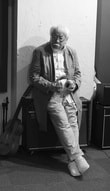
The gagaku music that the composer Toru Takemitsu heard 65 years ago comes back to life: Mayumi Miyata talks about the world of Shuteiga.
Shuteiga: The piece that changed two lives
Mysterious things can happen. A single musical composition impacts the course of someone’s life. What is more, it completely transformed the lives of not just one, but two. One was Sukeyasu Shiba, a gagaku musician. The other was Mayumi Miyata, who had graduated from a college of music as a piano major and was preparing to study the aesthetics of music. In pursuit of a more refined interpretation of this piece, Shiba resigned from the Imperial Household Agency’s Music Department to found the gagaku ensemble “Reigakusha”.1 Captivated by this composition, Miyata aspired to study the sho and attended a gagaku course instructed by Shiba. The work that altered the destiny of these two musicians was Toru Takemitsu’s Shuteiga (In an Autumn Garden).
Commissioned by the National Theatre in 1970 to write a new piece for gagaku, Toru Takemitsu composed Shuteiga (1973). Approximately a decade prior, having attended a gagaku performance at the Imperial Household Agency, he was deeply moved and wrote: “I had the impression that the sounds were rising, as if a tree were growing toward the heavens.”
Until now, no one had ever investigated exactly which piece of music Takemitsu had heard at that time. It has generally been accepted that Takemitsu’s encounter with gagaku occurred in 1962; however, in Toru Takemitsu: A Journey Toward Creation, Takashi Tachibana pointed out that the surrounding context of Takemitsu’s article strongly points to 1961 instead. Investigating further, Hiroki Shinoda, a concert producer at Art Tower Mito, contacted the Imperial Household Agency. He confirmed that the concert in question did indeed take place on October 6, 1961, rather than in 1962. Furthermore, the specific gagaku pieces that Takemitsu listened to have also been identified.2
In this upcoming concert, all four kangen (instrumental) pieces, which are performed without dance, and one of the three bugaku (dance) pieces, will be rearranged and performed alongside Shuteiga Ichigu (In an Autumn Garden, complete version) (1979). This performance represents a fresh attempt to shed a new light on the intersection of Takemitsu and gagaku.
After the words quoted above, Takemitsu reveals his profound fascination with the sho by observing: “Here, the sho is a particularly vital instrument... Could we not say that within the river of the sho’s sound lies eternal rest?”
Fascinated by the timbre of the sho, Mayumi Miyata describes the background of her transition to a new life path in the following words:
“This might sound a bit far-fetched, but I once watched rays of light streaming through breaks in the clouds, and I was struck by the feeling that it was just like the sound of the sho. Before that happened, I had already been interested in the music of Toru Takemitsu. I had a record of Shuteiga at home. I remembered that there was a sound just like that in the piece. When I went home and played the record, it was exactly as I had imagined. And so, I felt like maybe I should learn to play the sho, which is how I ended up taking lessons. Rather than through traditional gagaku music, I actually discovered the sound of sho through Takemitsu’s music, and that is what led me to start learning it.”
Shuteiga and the gagaku repertoire Takemitsu listened to 65 Years Ago -
The E note representing autumn
What makes this concert truly captivating is the chance to see how the gagaku Takemitsu heard in 1961 may be connected to Shuteiga. Miyata offers her insight:
“The initially composed version of Shuteiga incorporates some traditional gagaku methods. For instance, there’s shindo-byoshi—where the drum beats progressively faster and faster to create a vibrating rhythm—and then there’s that 5-beat pattern, a ‘1-2, 1-2-3’ rhythm. The bugaku piece Genjoraku (of the Right) features a five-beat meter, and a five-beat rhythm - known as yatara byoshi -appears in the final section of Shuteiga. I think features like that are rooted in gagaku. Furthermore, pieces belonging to the taishikicho mode, such as Taishikicho no Netori, Gakkaen, and Batto, feature the hyojo pitch (the note E) as their tonic note. Interestingly, the bugaku piece Genjoraku also shares this exact same E note as its tonic. In gagaku, the hyojo pitch (the note E) has traditionally been associated with autumn. Even though their scales are different, both the hyojo mode and the taishikicho mode share this same pitch as their fundamental tonic. Mentor Shiba suggested that Shuteiga was likely built around that identical E note as its tonic as well.”
This indicates that, as a whole, the gagaku pieces performed at the concert in 1961 used the note E, which symbolizes autumn, as their tonic, and Takemitsu may have followed this tradition when composing Shuteiga.3 Miyata goes on to describe what to listen for in this composition.
“While Genjoraku of the Right features a five-beat meter, its ‘1-2, 1-2-3’ rhythm is used in the fourth movement of Shuteiga Ichigu in a way that truly inspires one to dance, driving a gradual crescendo of excitement. You get this feeling of rising upward in a spiral, and it’s absolutely beautiful. There is a feeling of life rising. When we first performed Shuteiga Ichigu, I was in charge of the dance rather than the musical performance. I remember it giving me this genuine sensation of a quiet excitement steadily ascending.”
Shuteiga Ichigu adopts a symmetrical spatial layout, placing the ‘Shutei (Autumn Garden)’ at the center of the stage, ‘Kodama (Echo) Group 1’ at the back, and ‘Kodama Group 2’ and ‘Kodama Group 3’ to the left and right of the audience, respectively. Regarding the arrangement of the twenty-nine performers – nine of whom play the sho – spaced apart from one another, she comments:
“Surrounded by the sound, responding to resonances echoing from the distance, it feels wonderful to become a part of that harmony yourself. We actually performed at Meiji Jingu Shrine once; we were positioned in various spots throughout the garden. Making music surrounded by nature was a very happy experience.”
The Allure of the Sho
Distance (1972) for oboe and sho, commissioned by Heinz Holliger, will also be performed between the kangen and bugaku pieces. Upon commissioning the work, he had a sho crafted specifically in Kyoto and presented it to Takemitsu as a gift. Miyata looks after this instrument, which she received from Takemitsu. Now the instrument has improved in condition after several adjustments, and may be used for future performances of Distance.
The sho is now performed all over the world, and this is largely due to the dedicated activities of such an outstanding player as Mayumi Miyata. Why has the sho become so widely embraced?
“The sound of the sho consists of continuous chords that generate overtones and difference tones, and I believe there are an immense number of sounds within them that interact with the human body. Those difference tones give you the impression of a sound echoing from another world. The overtones also give you the feeling that they are resonating from a completely different realm. The sho possesses both of these qualities. While the fascination of difference tones and overtones can be created with just two notes, the sho is usually played with chords of two or more notes. It evokes a feeling as though the music is floating in from an unidentifiable point in space; I suspect it is this very quality that draws people so deeply to its voice.”
Just as Sukeyasu Shiba reconstructed music from Dunhuang pipa scores for restored instruments of the Shosoin repository, Miyata has also recently been reconstructing and performing lost works dating from the Kamakura to the Muromachi periods, as well as ‘secret pieces (hikyoku)’. Genuinely enjoying her work, she frequently marvels, “I wonder why this is so incredibly interesting.” Expressing her goals as Reigakusha’s new music director, she stated her intent to base future activities on classical repertoire, cherish Sukeyasu Shiba’s music along with Shuteiga, and pursue higher performance with the ensemble.
In this upcoming concert of “Konjaku Gagaku-shu IV” (Gagaku from times past IV), the very gagaku pieces Toru Takemitsu listened to 65 years ago will be performed alongside his masterpiece, Shuteiga Ichigu. This will undoubtedly be a precious opportunity to discover the profound connections between classical gagaku and Takemitsu’s music.
1) Shiba remarked, “I experienced for the first time how a single piece of music can completely change one’s life plan. Shuteiga gave me the true joy of making music,” describing the background of how he resigned from the Imperial Household Agency to form Reigakusha. From the CD Toru Takemitsu: Shuteiga Ichigu, performed by Reigakusha (Sony SICC 85, 2002).
2) In 1961, the gagaku pieces that Takemitsu heard at the Imperial Household Agency were as follows:
Kangen (Instrumental): Taishikicho no Netori, Gakkaen, Roei (Singing) Kashin, and Bato
Bugaku (Dance): Kanshu, Genjoraku of the Right, and Ninnaraku
*Underlined items indicate the pieces to be performed in this concert.
3) Hiroki Shinoda, “Memories of Autumn: From Toru Takemitsu’s Gagaku Experience to Shuteiga,” Vivo, Vol. 278 (September 2026 issue), p. 6.