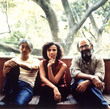
As reported in our previous issue (Intoxicate Vol. 179), “Music Creators Development Project—Tokyo & Paris to the Next” is inaugurated by the Tokyo Bunka Kaikan in collaboration with France’s IRCAM (Institute for Research and Coordination in Acoustics / Music). Over the five-year period from 2024 to 2029, the project will dispatch three composers and one engineer to France in rotation. Following their residencies at IRCAM, thee commissioned compositions will be premiered in Paris and subsequently in Tokyo. Hibiki Mukai, the first selected participant of this long-term initiatives, has been in preparation since last year and began working on his composition at the end of 2025.
“I spent five days this past December at IRCAM within the Centre Pompidou, during my stay. I conducted an experiment where I fed computers recordings of Onna-Gidayu (female Gidayu) vocals from previous collaborations and programmed the system to sing. Collaborating with Serge Lemouton, with an IRCAM computer music designer, we implemented a model by running multiple AI training epochs, using approximately 40 minutes of audio data. After three days of machine learning, we were successfully reproduced the specific vocal qualities of Jōruri, including the vocal grain and the breathiness of the singing voice.”
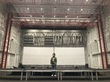
“Would you like to listen to it?” Mukai asked. Indeed, the resulting sound from his smartphone was impressive, skillfully capturing the inherent textures of Joruri narration. While a playback might immediately be indistinguishable itself from existing generative AI, that is where IRCAM comes in—the birthplace of Max. Here, even traditional music outside the Western canon—rich with aperiodic components—is treated as a universal sonic phenomenon through the lens of a scientific approach. Though native speakers might find the semantic layer uncanny, the fidelity of the reproduction is extraordinary. In Mukai’s idea, these models will be fed instrumental pitch data to output the synthesized voice of Onna-Gidayu. The planned performance will take place in IRCAM’s Espace de Projection, equipped with a 360-degree multi-speaker environment. Mukai’s current vision involves a five-piece ensemble—comprising three strings, flute, and percussion—whose sounds are processed through live electronics. As these sounds are spatialized and moved through the hall, the instrumental tones will gradually metamorphose into the Onna-Gidayu voice.
This project marks a “fortunate encounter” between Mukai’s expertise in live electronics—cultivated through works like “Machine Skin” and “Bishoujo Kakumei for Harp and Electronics”—and IRCAM, the sanctuary of electronic music established by Pierre Boulez whose centenary was celebrated last year. Approaching this project, there were certainly moments when he felt the weight of expectation that comes with working in such a historic sanctuary of electronic music.
“There were moments when I thought, ‘What have I gotten myself into?’ (laughs). Working with Serge Lemouton, who has produced electronics for masters like Philippe Manoury and Luca Francesconi, and realizing I was in the same studios used by Kaija Saariaho, I felt the profound weight of history. But that’s exactly why I want to make my own mark. I love mixing genres—I want to create something cool by weaving together contexts of electronica, techno, and experimental music. When I played some fragments of my ideas for Serge, he asked, ‘Are you really going to do that here?’ but then added, ‘Actually, why not?’ It gave me the green light to keep pushing the envelope and to challenge IRCAM's established academic conventions.”
This spirit of adventure perfectly is in line with the mission of developing young creators, yet Hibiki Mukai believes that his inherent color emerges only through such challenges. This ‘color’ is an embodiment of sonic gradation, encompassing his extensive experience composing for orchestras, his dynamism to collaborate with traditional Ningyo-Jōruri and Portuguese puppet troupes—even organizing their Japanese tours—and an insatiable musical appetite that devours everything from Autechre to Reggaeton. It is a gradation of sound that is constantly expanding.
“Regarding how to convey the essence of a work,” Mukai says, “anxiety haunts me before and after composing, and even before and after the performance. In the end, I often find myself praying for a miracle (laughs). But even if I try to avoid complexity, I believe it’s nearly impossible to compose music that resonates with everyone across their diverse values. That is why I refuse to compromise on the work itself. From start to finish, my priority is simply to compose it by myself and focus entirely on achieving the highest possible level of perfection.”
As a music fan, I want to look forward to its premiere in 2027.
CONCERT INFORMATION
Music Creators Development Project Final Presentation
Premiere Concer
Date: Fri, Feb 26, 2027 19:00 (Open 18:30)
Venue: Hamarikyu Asahi Hall
■Program
KITAZUME Hiromichi: sparking (2011)
MUKAI Hibiki: Co-commission by Tokyo Bunka Kaikan and IRCAM [Electronics included] *Japan premiere
MUKAI Hibiki: New work [String quartet] *World premiere
Mei-Fang LIN: RemembeЯ (2025) *Japan premiere
Philippe HUREL: En filigrane - Quatuor n°3 (2020) *Japan premiere
NODAIRA Ichiro: Enigme (2006)
For Further Information : https://www.t-bunka.jp/ttn/en/index.html