アレクサンドル・デスプラ 初のオペラ「サイレンス」をパリで観る
川端康成の短編「無言」を題材にデスプラが問う
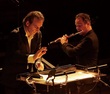
アレクサンドル・デスプラは、「真珠の耳飾りの少女」から、アカデミー賞作曲賞に輝いた近作の「グランド・ブダペスト・ホテル」「シェイプ・オブ・ウォーター」まで、繊細な感性に満ち、エスプリの効いた映画音楽で知られている。そのデスプラの作曲した初のオペラ「サイレンス」が、ルクセンブルク(2月26-27日ルクセンブルク大劇場)とパリ(3月2-3日ブーフ・デュ・ノール劇場)で初演され、音楽界の注目を集めた。
彼は今まで、映画や舞台とは関係ない純粋な音楽作品として、フルート協奏曲や管弦楽曲なども作曲しているが、いわゆる声楽作品はない。ヴィブラートの効いた歌唱法や少しオーバーなロマン派のオペラ的表現は苦手で、彼の音楽世界とは相容れないとのこと。今回もオペラと言っても、小編成で、薄くデリケートな響きの得られる、ソプラノ、バリトン、語り各1名と10人の器楽奏者による室内オペラという形が取られた。
台本も、淡々とした幻想性から選ばれた、川端康成の短編「無言」に基づいている。デスプラと共同で台本を手がけたヴァイオリニストのソルレイ(ドミニク・ルモニエ)は、公私にわたる長年のパートナーで、演出、ヴィデオ映像もソルレイが担当した。2人は、このオペラで、数年前、脳の手術の後遺症でソルレイの左手の指が以前のように動かなくなってしまったことと、「無言」に登場する作家が、脳卒中により言葉を失い、書けなくなったことを重ね、表現手段を失った芸術家はどう生きていくのかという問いを掲げる。もちろんこの舞台では、それに対する明確な答えはないままに、現実と虚構、想像の狭間で、言葉や想いが夢の中の出来事のように曖昧に漂っていたのが絶妙であった。
デスプラの音楽では、同じ楽器を3つずつ用いる雅楽にちなんだ楽器編成(フルート3、クラリネット3、弦楽三重奏、打楽器)、音取にも似た冒頭の音楽、酒を飲む場面での篳篥風のピッコロ、箏のような弦楽器のピッツィカート、邦楽の五音音階と、声と楽器のユニゾンなど部分的に日本らしさが取り入れられてはいたが、大半はミニマル・ミュージック的であったり旋法が響いたりと、彼らしいきめ細やかな音風景の中に様々な要素が混ざり合っていた。とくに、憂いを帯びた、短3度下行する2つの音のモティーフが何度かくり返され、宙ぶらりんの状態を表すかのように虚ろに響くのが印象に残った。また、録音された、ソルレイの即興によるヴァイオリンの音が、時折〈幽霊〉として、生きた亡霊となってしまった作家やトンネルの中でタクシーに乗ってくる女の幽霊を象徴するという趣向も味わい深かった。
声の旋律は、ドビュッシーやプーランクなどを想起させる、フランス語の言葉を聴きとりやすいものだった。できるかぎりヴィブラートを取り去った、飾りのない声、削られた表現が川端作品とよくマッチしていた。

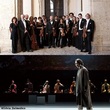
ソルレイの舞台空間には、器楽奏者たちのスペースが後方に置かれていて、モノトーンの舞台セットや3人の歌手と語り手の衣装に対して、「自然をイメージした」色とりどりの衣装(ヴァレンティノのピエールパオロ・ピッチョーリ)を身にまとった奏者たちが舞台の一部として存在感を醸し出していた。抽象的な衣装ではあるものの、どこかアジア的で、指揮者が前に立っていないことも手伝い(デスプラは舞台袖で指揮し、奏者は場内の小スクリーンに映し出された指揮に合わせて演奏した)やはり雅楽の演奏の様子との雰囲気の類似を思わせた。
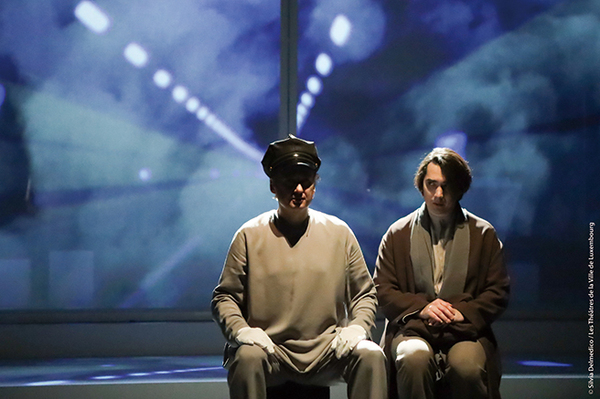
スペースは、後方から、演奏空間、作家の家の中、車での道中など語りの場面で使われる空間と、3つに分かれ、開閉する半透明のついたてに時折、隔てられる。数字の3はシンボルとして、スペースだけではなく、登場人物の数、音楽、時間にも使われていた。舞台セットは床と椅子、鏡のみで極めて簡素(舞台美術・照明はエリック・ソワイエ)。まっすぐな黒髪で、お辞儀をする作家の娘と弟子、タクシーの運転手役は制帽に白手袋をはめるなどの日本的な要素はリアリスティックである。映像も、作家らしき日本人男性の眼、テレビのプロ野球の試合、あるいは幽霊を表す着物を着た女など、詩的な美しさはありながらも、川端の精神をリスペクトする形で〈日本〉を表していた。単なるジャポニスムにはならない、彼らの川端の小説の世界と日本文化への愛が、エトヴェシュや細川のオペラともまた異なった形で、 独自の美学と見事につながった舞台だったと言えよう。
カミーユ・プルは伸びやかな声音で低音域までしっかりと響かせ、控えめながらに父の代弁をする娘富子を、また、ミハイル・ティモシェンコも暖かい音色で、作家を見舞う、弟子三田役を幻想的に演じた。また、ナレーションと、タクシー運転手などの端役を語りで担ったサヴァ・ロロフは、原作の軽やかさや味わいとも微妙に違うニュアンスの、ややシニカルなトーンで重いテーマの湿っぽさを払いのける役割を果たしていた。
アンサンブル・ルシリンの演奏も出色で、デスプラの音楽の、眼に見えないものを描き出す、微細につくられた陰影を細やかに表現していた。
来年1月、神奈川県立音楽堂とロームシアター京都で日本公演が予定されている。折しも今年生誕120周年の川端の作品を題材にした、フランス人映画音楽作曲家で日本通のデスプラのオペラが、日本でどう受け取られるか、とても楽しみである。
A World Premier Concert in Paris,
First Opera of Alexandre Desplat’s Silence - Based on Yasunari Kwabata’s Same Title Short Story
Text in Japanese: Yuki Kakiichi
Alexandre Desplat is a well known film composer with his delicate touches and witty remarks on his film scores from Girl with a Pearl Earing to two recent Academy Awards winning ones, The Grand Budapest Hotel, and The Shape of Water. His first opera Silence was premiered at Grand Théâtre, Luxembourg
(Feb. 26, 27) and Théâtre des Bouffes du Nord, Paris (Mar. 2, 3) , and gathered attention from the world.
His list of whole compositions has a few works as a piece for solo flute and a concerto for flute and orchestra which exclude film or theater related works, but no vocal composition at all, up until this opera. He avoids the vocal style with vibrato, and exaggerate operatic expression of romantic style. The idea of chamber ensemble comprised of one for each of soprano, baritone, and narrator, and 10 for instrumentalists enables him to realize subtle and nuanced orchestration for this opera.
The script is based on the Silence, a short story by Yasunari Kawabata. It was chosen because of its detached and phantasmagoric aspect. The violinist, Solrey (=Dominique Lemonnier) who has been Desplat’s partner both in business and private, is the co-writer of the script. She is the director of dramatic interpretations, acting plans, and also the images on the video. An accident occurred in the story that a novelist lost his ability to write due to the stroke, overlaps the real one of Solrey's, that the aftereffect of her brain surgery disabled her to move her left fingers as well as she could before. So, in this Opera, the question, how the artists who lost their own expression means could survive, is raised by Desplat and her. Intentionally, this question remains unanswered throughout the performance. The words and thoughts distracted between the real and fiction, or illusion as in dreams, successfully bring impacts on the drama.
His instrumentation of the opera is partially tinged with Japanese traditional music , having such intakes from “gagaku” as the orchestration by the threes of same instruments (3 flutes / 3 clarinets / String Trio / Percussion), its opening sound evoking Netori ( collective voicing or tuning ), the scene with booze having hichiriki tone by piccolo, tone of plucking Koto by pizzicato of strings, pentatonic scales of Japanese traditional music, and unisons of instrumentals and vocals. But there you will find the composer’s signature sound surfacing subtle nuances, in the mixtures of different soundscapes over the echoes of modal and minimal music manners. Two notes motif of descending minor third, played several times repetitively, left me a strong impression by its emptiness, referring to unsettled moments in the script. Another impressive finding was that prerecorded footage of Solrey’s violin, which signifies the “ghost” to describe the writer as a living ghost, or a female getting on the taxi as the one.
Vocal melodies remind me of those of Debussy’s, or Poulenc’s, which keep clear articulations of French. Vocals cut as much vibrato as possible, simple vocal style without any ornamentations, these intentionally conceived expressions for the voice fit well into those of Kawabata’s text.
The stage plot by Solrey, locates the musicians at the back. Their colorful costumes, reflecting images of “nature” (designed by Pierpaolo Piccioli - Valentino) create unique presence as one part of the stage design, against colorless stage sets, two singers and a narrator. Costumes, not figurative yet Asian, together with the absence of conductor on the stage (Desplat conducts ensemble at the stage wing, and the small screen in the theater enables ensemble to follow his conduction ), also insinuates the formation of gagaku performance.
The stage is divided into three section. These 3 sections are arranged from the back to the front as follow; each for the ensemble and writer’s house, and another for the narrator. These are occasionally separated by half transparent screens to be opened and shut. The number “3” functions as the symbol, not only for the division of the stage, but also for the characters, music, and the duration. Only floor, chair and mirror are the stage props. The set is designed in the simplest manner as possible (Stage and lighting design by Eric Soyer). Japanese manners of the characters appeared in a daughter of writer’s and disciple in black straight- haired who bows politely, and a taxi driver in white globes with a uniform cap on, are realized properly. Eyes of Japanese male novelist, games of professional baseball on TV, or a woman in Kimono, a ghost with metic beauty, these images on the screen, showing directors’ homage to the spirit of Kawabata, accurately render “Japan” as inscribed in his works.
Their deep understanding and love of Kawabata’s novels and Japanese cultures, which keep direction of the production away from “Japonism”, an exoticism, has bridged to another possible opera world through unique interpretation by their own aesthetics, which is differed from that of Toshio Hosokawa’s and Péter Eötvös’s.
With ductile vocal ability to control even in lower range, Camille Poul beautifully performed the roll of Tomiko, a reserved daughter but who speaks for her silent father. And Mikhail Timoshenko successfully created visionary appearances of Mita, a disciple visiting his master. Sava Lolov, a narrator for many different characters, played a roll to exorcise wet, depressed impression by cynical tone which is slightly different nuances of the original text.
The performance of Ensemble United Instruments of Lucilin was phenomenal, and represented the orchestrations with meticulous details of Desplat’s to render invisibles.
The opera is coming to Japan next January, to be performed at Kanagawa prefectural Music Hall and ROHM Theater Kyoto. It will be very interesting to see how Japanese audience will receive the opera based on the interpretation of Kawabata’s short story by Desplat, a french film music composer, and an expert of Japan, a year after 120th anniversary of Kawabata’s birth.
translated by Kazuki Takami(intoxicate)
FEBRUARY 26-27, 2019 & MARCH 2-3, 2019 | SILENCE
CONCERT
World Premiere of Silence, A chamber operina for 1 mezzo-soprano, 1 baritone-bass, 1 comedian and 10 musicians
Music by Alexandre Desplat, libretto by Alexandre Desplat and Solrey after Silence by Yasunari Kawabata
With Camille Poul (soprano), Mikhail Timoshenko (baritone-bass), Sava Lolov (comedian, narrator)
And ensemble United Instruments of Lucilin
At Grand Théâtre, Luxembourg, 1 Rond-point Schuman, L-2525 Luxembourg (Luxembourg)
· Tuesday February 26, 2019 at 20:00
· Wednesday February 27, 2019 at 20:00
At Théâtre des Bouffes du Nord, 37bis Bd de La Chapelle, F-75010 Paris (France)
· Saturday March 2, 2019 at 20:30
· Sunday march 3, 2019 at 16:00
CREDITS
EN SILENCE
by Alexandre Desplat & Solrey
based on a novel by Yasunari Kawabata
Libretto: Alexandre Desplat & Solrey
Composition and musical direction: Alexandre Desplat
Direction and video: Solrey
with: Camille Poul (soprano), Mikhail Timoshenko (bass-baritone), Sava Lolov (narrator)
Ensemble United Instruments of Lucilin:
André Pons-Valdès (violin), Danielle Hennicot (viola), Ingrid Schoenlaub (cello), Sophie Deshayes (flutes), Gionata Sgambaro (flutes), Pierre Golse (flutes), Marcel Lallemang (clarinets), Max Mausen (clarinets), Christelle Pochet (clarinets), Guy Frisch (percussions)
Vocal coaching – associate music direction: Emmanuel Olivier
Stage and lighting design: Eric Soyer
Costume design: Pierpaolo Piccioli
Artistic collaboration: Charles Chemin
Collaboration to movements: Mélanie Lomoff
Production: Les Théâtres de la Ville de Luxembourg
Coproduction: Galilea Music, United Instruments of Lucilin, C.I.C.T. – Théâtre des Bouffes du Nord
In association with: EdM Productions