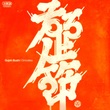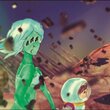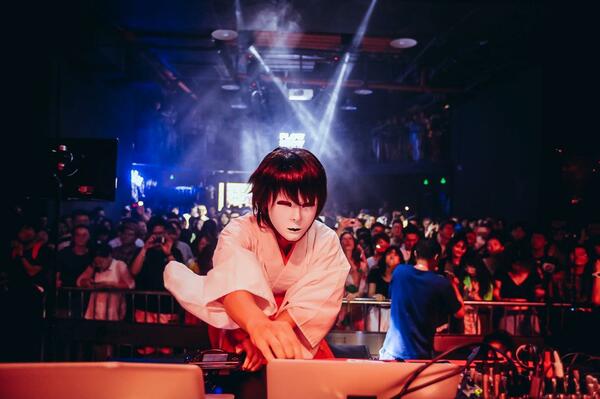
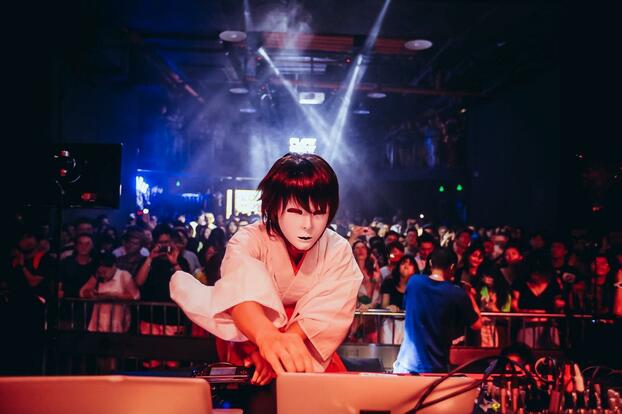
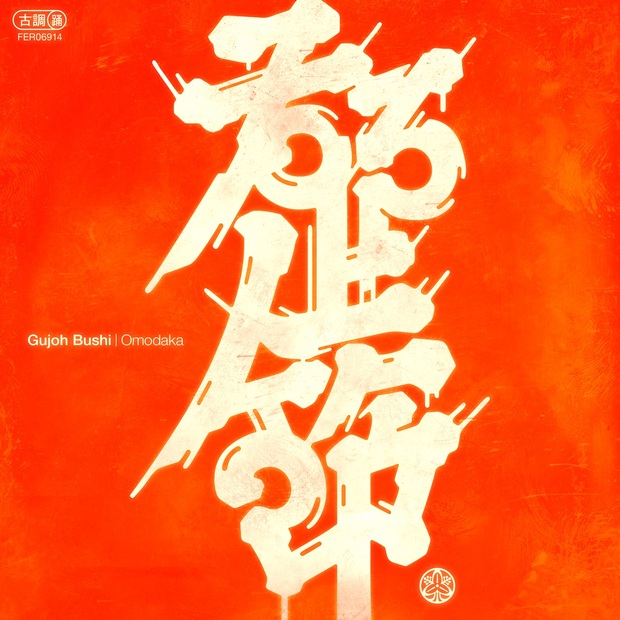
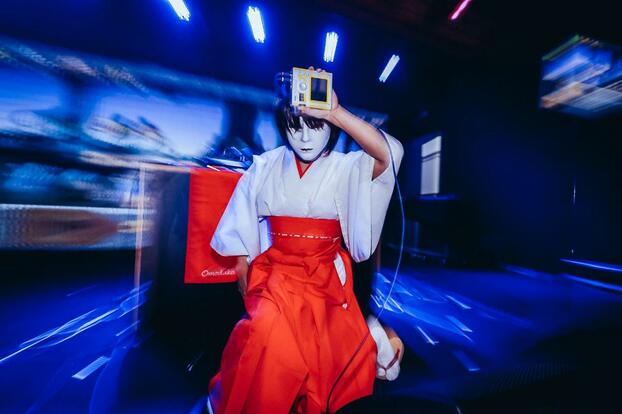
Since 2001 Omodaka "An experimental project combining techno folk songs and motion graphics" has been a project launched by Soichi Terada,who is the creator of early Japanese House Music scene. In addition to the unique musical characteristics of folk songs, electro beats and chip tune, the live performance in which Akiko Kanazawa, a folk song singer who is also known for "Yellow Submarine Ondo" appears on LCD monitors, while Omodaka with white mask in a shrine maiden costume uses portable game consoles and Kaosillator . It has had great responses not only in Japan but also in Europe, North America and Asia since its start in 2009. Omodaka will release the 3rd album in 5 years "Gujoh Bushi" on Monday October 28. From the secret story of Omodaka's birth to his present and future activities. I spoke with Soichi Terada himself.

Omodaka started from boat racing
-Though you have been active since the 80's, Omodaka started its activities in 2001. At that time, you made a lot of songs with the theme of "Kyotei" the Japanese boat racing, right?
At that time, I happened to make songs for Mah-jong and Pachinko, so I thought, "next must be a boat racing", so I created that without knowing much about boat racing. There was a big competition at the boat race course where I went for the first time, and many people was wandering around, and there were bloody fights, and its wild nature was shocking and interesting for me. From there I'm totally hooked on it. After losing much at the boat race course, I used to return to make a song. Then the music is combined with a video created by a filmmakers. That was Omodaka's early activity. In the same time I was working on the current style of putting folk songs into completely different tracks, but the main work was the songs of the boat racing.
-Which is the first thing you thought of “Let's start a project called Omodaka” or “Let's make a song about boat race”?
When I decided to start a project called Omodaka in 2000, the first song was a boat race song, so I think it was about the same time and Omodaka was a little bit ahead. The sort of vision of "What to do with Omodaka" was very dim back then.
-So, did the theme "An experimental project combining techno folk songs and motion graphics" in your current Omodaka profile become established later?
It was also an occasion to make a techno folk song, but I was more interested in a boat race at that time. But over the years, Omodaka's music started to be called "techno folk song" by third parties, which led to this profile.
-Theme of Kyotei the boat race would be completed with 'Favorite Games' in 2008,right?
I thought "Let's make six songs about boat racing" because 6 boats run in the boat race, and I made CD jackets to match those 6 colors. In 2008, 6 works were completed, so I finished the series.
-Did Omodaka shift to techno folk songs from there?
I've been performing live since 2009, but that doesn't mean I had a sense of "Create another theme that will follow the boat race." or "I'm going to play a folk song.". Eventually Omodaka would play Minyo the Japanese folk song.
Dehumanizing human
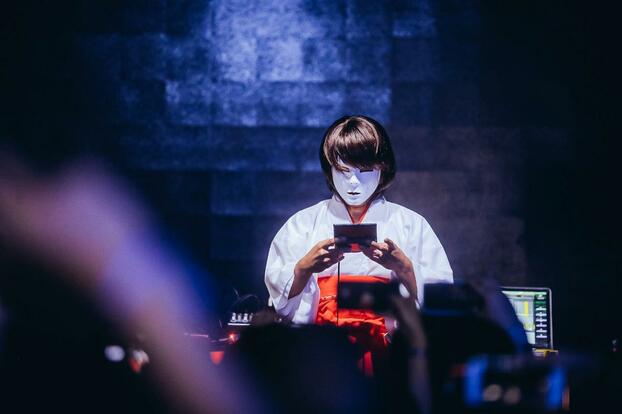
-In the live performance, you are dressed as a shrine maiden wearing a mask, have a portable game consoles or a Kaosillator in your hand, and play the genre of techno folk songs. Each element is too strong. First, please tell me about the appearance. Has that appearance been like that since 2009?
That look and the fact that Omodaka has had the singing LCD on the stage since 2009.
-It's exactly 10 years old. Why were you wearing as a shrine maiden?
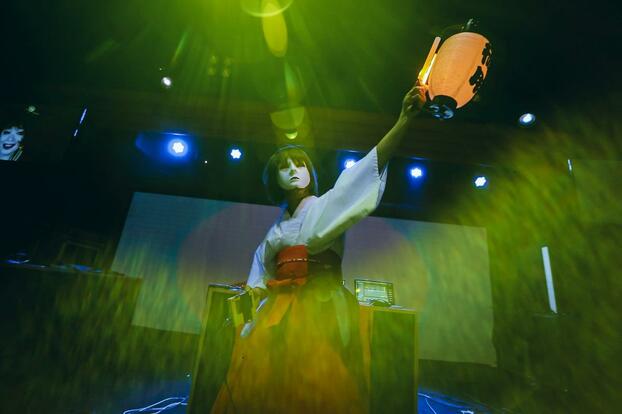
I don't know why... I think that live shows are to show the audience the songs or the performances, but I prefer to show the videos I made with the filmmakers. That's why I didn't want people on the stage, and I wanted dehumanized human, or make them objects or ghosts. Also, I think it's because I wanted to do Omodaka with a Japanese horror image. I'm just wearing a mask because I want to block the personality from the performers. DJs can play songs without a singer, but when I started playing, I had a lot of occasions to play with the band, so I thought it was a fatal flaw that there was no one singing on the stage.
That's why Omodaka shows Akiko Kanazawa's singing on LCDs. Even though people are necessary for the stage, I thought I would be better not to be human in order to make the person singing on LCDs standing out. However, as I performed live, I came to realize that it would be more fun for audiences to show its personality even if they are such a creepy person.
-Does anyone know that a creepy man indise is Soichi Terada?
I don't hide it, so I think that people who know it have a sense of affinity. Recently, Omodaka has been associated with me a lot.
-Soichi Terada has been a member of the Japanese house music scene since the very beginning, but it is difficult to decide whether it is better to see it in relation to "Actually, that's the guy in Omodaka." or to think separately.
It doesn't matter, of course, but as for Omodaka's performance, I want it to be enjoyable whether you know it or not. For example, there are some spin-off movies, and people who don't know the main story can enjoy the world view, and people who know the relation with the main story can enjoy more by connecting the lines.
-You have been doing a lot of live activities in house sets recently, and have you drawn the boundary between them?
The live performance of Soichi Terada house set started in 2015, and there are some new songs that are played in both the house set and Omodaka. So I don't mean to use them separated clearly, but they may be approaching. There is a song that was remade after Kanazawa sang it again for Omodaka, even it was originally made with a house set. And there is also a track that Shinichiro Yokota made in the 90's that was remade for the recent Omodaka. Whether you're aware of it or not, the two may be getting closer.
-What about performance? Omodaka is jumping and dancing, but is it becoming the same with Soichi Terada house set?
Even if I think it's different, the body movement seems to be the almost same for those who watch both. They look different though.

Making sushi with what I ate and found delicious
-The appearance is also characteristic, but personally, when I first saw the live concert, the first song was "Sangai Bushi" and I was shocked by the harmony of that song. Where does these unique way of using chords come from?
As for Japanese folk songs, melodies are refined and you can listen to them, but on the other hand, chords and rhythms are not so much part of Japanese folk songs.That's why I thought that such refined melodies have a chance to be re-harmonized from a completely different place. The chords of "Sangai Bushi" were not come from traditional Japanese folk songs, but rather the chords of jazz organs or hymns. Even if you bring that kind of harmony to Japanese folk song, it may fit perfectly depending on the thing. This re-harmonizing is especially between a jazz organ and a church organ.
-If you make a mistake, the sound and sound will hit each other and make you feel sick. It seems to feel good at the last minute. Are other songs based on such music?
Basically I try to put the chord progression I brought from other songs on Japanese folk song and find a match. In some cases, Akiko Kanazawa improvises a song on top of tracks.
-In this album, there are various genres like Mambo and Bossa nova phrases, and I think you study music from all over the world.
I'm not doing much research though,all I have to do are repeating the code progressions that I like, trying to put various folk songs on them, and finding the right combinations. Indeed that might be something like research or experimentation, I feel like I'm making sushi with what I ate and found delicious.
-Jazz and rock, for example, have been tried and adopted by many artists, in the other side I think it's rare to combine Japanese folk songs, mambo, and chip tune. I thought the reason why folk songs are easy to match with various genres is that there are many songs without accompaniment because of oral tradition.
Indeed. Japanese folk songs were passed down by mouth, so even though they were the same folk songs, they were a little different in each region, and some of the songs passed down were almost extinct. In the 20 century, recording techniques and printing were developed, so there was a movement to record them directly or record them on scoring, and then they remained.
There is an impressive episode about "Kokiriko-bushi" which is also included in this album. Actually, "Kokiriko-bushi" has been sung for about 1800 years, but one day in 20century there was only one grandmother who could sing it in Toyama Prefecture. Fortunately it didn't become extinct because someone recorded it in the Showa era.
-Oh, I think it has something to do with Omodaka's activities. On the other hand, you are not dealing with only traditional folk songs like but you are dealing with a new folk song which was born in Showa era like "Chakkiri Bushi",right?
I didn't know that "Chakkiri Bushi" is a new folk song, and I didn't know that until I asked Akiko Kanazawa about it, even there are many cases like that. "Chakkiri Bushi" is a folk song made in the Showa era, which is less than 50 years since the composer, Kasho Machida died. Its lyric was written by Hakushu Kitahara. Kasho Machida is not only a composer, but also a researcher who has continued the activity of collecting local folk songs, and perhaps the original form of "Chukkari Bushi" may be a folk song somewhere. It may have been created by what we now call remixing or editing, and I find it interesting very much.

Meeting Japanese folk singer Akiko Kanazawa
-Is the vocal of Akiko Kanazawa prepared in advance? Or does she sing for Omodaka?
What we use under the name of Omodaka is recorded for Omodaka. As I said before, in order to do an experiment like "Does this cord progression fit this vocal?", we sometimes have Kanazawa sing it with the accompaniment of pure Japanese traditional music, and extract it to just a vocal. On top of that, once the shape is made, Kanazawa may sing it again or use it as it is.
-When it comes to Kanazawa, She is already a legendary figure in the Japanese folk music scene though, what is the appeal of her voice?
Kanazawa, of course, both the tone of her voice and the expressive power of her songs are wonderful though, other than that, the jazz improvisation where you can think of a melody line just by listening to a rhythm or a backtrack is very good. Like a rapper who begins to rap as soon as they listen to a track, she sings a folk song on top of another song. I think she has more than the so-called "singer".
-Does the track of Omodaka change the way Kanazawa sings or the melody line?
Yes,it does. It is often the case that she intentionally change the way of singing to match the Omodaka track when she were asked to re-sing from the first temporary recording. On the other hand, there are cases where they are too smooth against the Omodaka tracks. We use the temporary vocal in those case.
-Isn't it a hard work for both Kanazawa and you?
There are times like that, and there are times when we can do it quickly.
-Also, Kanazawa appears a lot in the LCD screen in the live performance, doesn't she? As a viewer, I'm just worried if Omodaka can transform her that much.
From the begining, it was said that Kanazawa would not be able to sing on the stage of Omodaka, while I got permission to appear in LCD screens. Each song has a quite different makeup and hair style, Kanazawa's idea like "This song looks more interesting in this way" comes up spontaneously from her. Then when you think like "Wow, she's dressed like that!", it would be actually Kanazawa's own idea.

-I see.How did You and Akiko Kanazawa meet in the first place?
The occasion I listened to Kanazawa's songs was that in the early 90's there was a project to make Kanazawa's house mix. And I took a part of it for Kanazawa Akiko House Mix 1 though, I had never listened to Japanese folk songs before that.
-Now it is an unable project without Kanazawa, isn't it?
Kanazawa sang Omodaka including the video shooting, so I can't play Omodaka without her cooperation.
-"Tosa Minen" in this album is originally Kanazawa's song, and you also arranged its version, right?
Yes. I arranged original version of "Tosa Minen". Usually, changing the chord progression of a composer is NOT something we do in an arrangement, but the director understood and agreed to do that way like re-harmonizing. When the album was almost finished I wanted something completely different from folk songs, so I came up with the idea of covering Kanazawa's music with Omodaka. I just didn't care if it became bizarre. Then we recorded Kanazawa's vocal again.
-It became Drum'n' Bass style which is completely different from the original. If they don't say anything, it's Omodaka's song, but if you know the original, they can possibly be surprised at that.
Yes,they can. I think it will be interesting if you listen and compare it with the original song.
From the self-cover song offered to Chisato Moritaka to YMCK's remix
-This is the first release in 5 years since the previous album, "Bridge Song", so it took pretty long time. What do you think about that?
I was going to make it a little earlier though,a year after the previous album, "Bridge Song" was made, House music work from my label was re-released as "Sounds From The Far East", and to play the songs, Soichi Terada House Set live were beginning to hold in overseas. It is about 4 years from 2015. I was so happy for myself, but on the other hand, I was exhausted physically, and the pace of making Omodaka's songs slowed down. Eventually it's been 5 years since 'Bridge Song'.
-When did the production of this album's work start?
Some songs were made a few months after the previous one was released in 2014,so that the album should have been ready in a few years. However after a while, I came up with an idea like "Tosa Minen" so I think it's better now.
-In addition to the folk songs, there were songs like 'Kirakira Bushi' or 'Nanca' from Famicom Cassettes "8 bit Music Power" "8-bit Music Power Encore" and Omodaka versions of songs by Akiko Kanazawa and Chisato Moritaka, which turned out to be a lot of content.
I was blank for 5 years, but during that time, I was able to collect the things I had made little by little and put them together like this, which was good.
-Among them it's a big topic of the Omodaka version of "Hyamikao" coming from the version provided to Chisato Moritaka.
Moritaka's "Hyamikao" is actually made from the voice of a new year song called "Ichigetsu Itsujitsu". When I edited the words, the meanings were separated and the words became meaningless lyrics, but there was a part where I could hear as "HYAMIKAO" and it became the title "Hyamikao". After that, I had Kanazawa sing "Ichigetsu Itsujitsu" in the same way and made this version with the same editing. However, it was strange that the way the consonant sounds is different depending on the singer, and even if you edit the same song, you can't hear the same lyrics for some reason.
-Did you note the work process to edit Moritaka's voice?
There was a note left writing, "bring this sound here" so I put Kanazawa's voice as same.
-You're doing something very unique, just like editing a break beats, right?
Oh, it's like rearranging break beats with a melody. I can say like trying to make the break beat on a different beat.
-There is also a remix of YMCK ("Kuwana no Tonosama" YMCK Bonzo style drum mix) , and a song edited by Jaermulk Manhattan ("Cowardly Ninjas" Jaermulk edit), and then this album has good guests.
Yes. YMCK joined us because I also made a remix for their new album. With Jaermulk Manhattan, Our mutual friend made a short film and we made the soundtracks together. I made a loop for the movie scenes and he organized it, and it was so interesting . Then I rearranged it from the one on the soundtrack.
-Also, "Air on the G String" by Bach is included as usual, isn't it?
It might be an order of Omodaka though, in every album I play Bach in covered version. When I made a song for a boat race, I made "Cantata No.147" as a parody once, and since I recorded it in the first album "Sanosa", one song would be included in each album after that. Actually, I made this "Air on the G String" for a compilation, then I changed the version a little.
-There is also the mixed song "Ryotsu Jinku" by Shinichiro Yokota who you talked about earlier.
The base of Ryotsu Jinku is a cover track of "Got To Be Real" made by Yokota in 90's, and Ryotsu Jinku was put on top of it and had been performed in Omodaka live for about 4-5 years. This version was also played in the Soichi Terada House Set.
-Does Yokota love YMO? There I could feel the influence.
Yes,he really does. Of course I like it too, but I think Yokota likes it more than I do because he has a cover of YMO in his solo work. I met Yokota about once a year after late 90's though, recently I have many chances to meet him because of the reissue from Rush Hour.

Chimeric folk songs for people who come beyond the time, the place and the culture
-This time, when I listened to the 1st song, "Kuwana no Tonosama", I felt that the feeling of 8-bit and chip-tune had decreased a little, did you change your consciousness or production environment in 5 years?
'Kuwana No Tonosama' is a folk song of Mie prefecture, and Kanazawa has released a CD limited to Nagashima Onsen in Mie prefecture. I put various elements in it, so it might have less 8 bit feeling. It may be true that the first half of the album has a specific feeling like "There seems to be a Game Boy as a part" however basically nothing has changed. Also, recently I have occasions to play live performances a lot, so I might think "How do I do it in the live?" unconsciously. Well,I am not very confident to say that because I often wonder how to play them in live after making them.
-In the latter half of the game, the feeling of chip-tune comes back, for example, I thought the sound was close to the Soichi Terada house set.
I didn't intend it myself, but there might be. I had the impression that I had overdone the standard 8-bit expressions, such as tremolo, so I often tried to play chords with the sound of NES or Game Boy instead of the standard expressions.
There are a lot of tips like "this instrument should be played like this." and I'm not tired of the standard expressions, I was wondering if there were any expressions that are different from those. I also found that if you do it too much, it will sound like a plain synth sounds.
-It's sounding beautiful, and I wonder why something called triangular wave or rectangular wave is sounding so beautiful. There are artificial waves that appeal to human emotions.
Yes. It's really wondering. I also feel that way. For example, I think like "What if I let people who have never heard the sound of a game console hear it?" and want to try it. To whom very old person, or a future person who doesn't know about NES or Game Boy.
-People in the future might think, "this is Japanese folk songs?" when they hear Omodaka.
I am grateful If sou, but they're not genuine folk songs. I would be happy if you think they're synthesized folk songs or chimera folk songs.
-Omodaka has already experienced overseas performances many times, and many people from overseas will come to Japan next year, so I want people from overseas to listen and watch Omodaka.
I hope people overseas also misunderstand that "Is this a Japanese folk song???". This year, I have precious opportunity to play Omodaka overseas such as Shanghai in June, and I am planning to play in Moscow at the end of the year.
-How has been the reactions from international audiences?
So far I've been there in North America, Europe, Australia, and China, and when they invite Omodaka, they used to look into things and understand Omodaka, then they all respond well and that made me really happy. Especially in China, electronic music seems to be popular now. That was an unexpected discovery.
-What are your plans for the future?
The album will finally come out, so I would like to think about a live performance based on its contents and play it in various places. In order to do that, I have to make a video of new songs, and there are some writers who want to ask for them. I have a lot of things to do though, it's really fun.